
Last Updated: October 21, 2026
Luxury fashion styling for men in 2026 starts with one idea: clothes should move with you, not against you, and that principle now guides every choice in luxury fashion styling. The stiff, narrow suit is gone from the conversation. What replaced it is softer tailoring, lighter fabrics, and pieces that work as hard on a Saturday as they do in a boardroom.
The jacket got roomier. Trousers dropped the tight taper. Shoulders lost their padding. This is relaxed tailoring, and it defines the year.
The old rule was “fitted equals formal.” The new rule is “clean equals formal.” A jacket can drape and still look expensive. In practice, that means you buy for the shoulder and let a tailor handle the rest.
Fabric is where luxury shows. A heavyweight wool coat earns its place in winter. For spring and summer, reach for lightweight fabrics like linen, cotton-linen blends, and fine merino.
Layering gets easier when each piece is thin. A lightweight overshirt over a tee beats a bulky jacket every time. The goal is functional luxury: pieces that breathe, pack well, and still look considered.
Quiet luxury outfits for men are built on fit, fabric, and neutral color, not logos. Elevated minimalism means fewer pieces, better materials, and a palette that works together.
Most trend roundups stop at describing the aesthetic. The useful part is the assembly: which pieces, in what order, for which occasion. Below are step-by-step formulas for the four situations that cover most of a man’s week.
For a more formal meeting, swap the oxford for a fine-gauge merino crewneck under the blazer and add a silk pocket square in a tone one shade off the jacket. For a business-casual Friday, drop the blazer and add a suede loafer.
The rule for travel is one layer you can remove without losing the outfit. If removing the jacket leaves you in a tee that reads as underwear, the base layer is wrong.
Evening quiet luxury is about texture, not shine. A matte wool and a soft suede read more expensive at night than a glossy fabric ever will.
If the invitation says black tie optional, a navy suit with a white shirt and a dark tie is the safe read. A tuxedo only if the room will be full of them.
Each formula leans on earth tones and seasonal colors that mix without clashing. Buy two or three pieces per formula and you have a working rotation that covers the week without a single logo in sight.
Finding your personal style is not a shopping spree. It is an editing job. Start with what already works in your closet, then add one or two pieces that sharpen the whole picture.
Here is a simple process:
This keeps you from chasing trends that do not fit your life. It also protects your budget. Most men do not need a new wardrobe. They need three or four smart additions and a tailor.
Fit is the difference between a good outfit and a great one. Proportion matters more than brand. Get the silhouette right and even simple pieces look expensive.
The one-inch rule is our go-to check. A jacket should close with about one inch of room at the chest. Trousers should break with about one inch of fabric on the shoe. Sleeves should show a half inch of shirt cuff.
By body type:
Men’s style over 50 is about confidence, not costume. You do not need to chase every trend. You need to borrow the ones that suit your build, your climate, and your week.
Adapt, do not rebuild:
The goal is to look current without looking like you tried too hard. A single well-chosen update reads as intentional. Five at once reads as a midlife crisis.
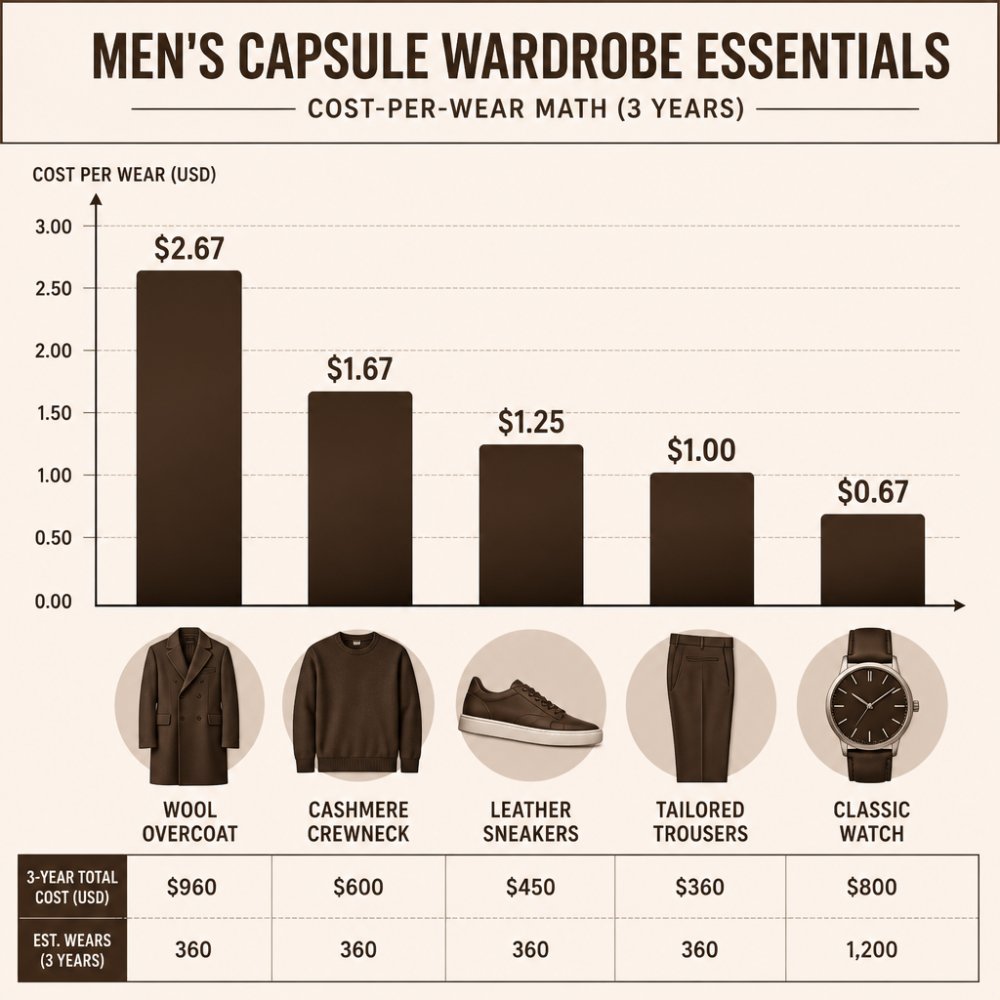
Men’s capsule wardrobe essentials are the pieces you wear weekly for years. The trick is judging them by cost per wear, not sticker price.
Most capsule lists are flat: buy these twelve things. That is not a plan. A plan tells you what to buy first, what to spend on each tier, and how to know when a piece has earned its place.
Tier 1, The Foundation (buy first). These are the pieces you will wear more than once a week. Spend the most here, because cost per wear falls fastest on high-frequency items.
Tier 2, The Layer (buy second). These extend the foundation across seasons and occasions.
Tier 3, The Finish (buy last). These are the pieces that make the wardrobe read as luxury rather than merely clean.
Cost per wear equals price divided by the number of times you wear it. A $400 coat worn 150 times costs about $2.67 per wear.
| Tier | Piece | Typical Price Range | Wears Over 3 Years | Cost Per Wear |
|---|---|---|---|---|
| 1 | White oxford shirt | $80-$200 | 150 | $0.53-$1.33 |
| 1 | Merino or cashmere crewneck | $150-$400 | 120 | $1.25-$3.33 |
| 1 | Dark straight-leg jean | $100-$250 | 200 | $0.50-$1.25 |
| 1 | Leather sneaker | $150-$400 | 200 | $0.75-$2.00 |
| 2 | Unstructured blazer | $300-$800 | 100 | $3.00-$8.00 |
| 2 | Suede loafer | $200-$500 | 150 | $1.33-$3.33 |
| 2 | Lightweight overshirt | $100-$250 | 80 | $1.25-$3.13 |
| 3 | Wool overcoat | $400-$1,200 | 150 | $2.67-$8.00 |
| 3 | Classic watch | $500-$2,000 | 900 | $0.56-$2.22 |
Start with the pieces you wear most and build outward. Buy the best version you can afford of the items you touch daily. For footwear, GQ’s guide to building a shoe rotation makes the case for fewer, better pairs.
Investment pieces only pay off if you care for them. Longevity is a habit, not a purchase. A little upkeep keeps fabrics looking new and protects the money you spent.
A care routine:
The FTC’s guidance on caring for textiles reminds shoppers that care labels exist for a reason. Follow them and your clothes last longer.
The strongest 2026 directions are relaxed tailoring with softer shoulders and fuller trousers, elevated minimalism (often called quiet luxury), and retro-inspired touches such as wider lapels and suede. Color leans toward earth tones like olive, camel, and chocolate brown, with seasonal colors used sparingly as accents. Premium fabrics and lightweight layers matter more than logos: cashmere knits, brushed cotton, and unlined outerwear carry the look. The practical thread is functional luxury, meaning pieces that feel as good on a Tuesday at the office as they do on a weekend.
Start with fit, not trends. A jacket that closes cleanly at the waist and trousers with a straight or gently tapered leg do more than any single purchase. For men’s style over 50, the reliable formula is a neutral base (navy, charcoal, stone), one texture per outfit (cashmere, suede, or brushed wool), and one modern detail such as a relaxed shoulder or a lighter-colored sneaker. Skip anything that requires constant adjusting. Buy fewer pieces, have them tailored, and rotate them. Confidence comes from clothes that fit, not from chasing every runway look.
Quiet luxury means the quality is obvious and the branding is not. In practice: no visible logos, precise fit, natural fabrics, and a tight color palette of navy, gray, cream, camel, and olive. A quiet luxury outfit for men might be a cashmere crewneck, tailored wool trousers, and clean leather sneakers. The point is that the garment reads well from two feet away and even better up close. It also ages better than trend pieces, which is why it suits a capsule wardrobe so well.
Audit what you already wear most, note the colors and fits that get repeated, then build three outfit formulas around them for work, weekend, and evening. Photograph each formula so you can repeat it without thinking. Add one new piece per season rather than a full overhaul, and test it against at least three existing items before buying. This is how to find your personal style for men without guessing: your habits tell you the answer, and the wardrobe plan just makes it consistent.
The real challenge in 2026 is not finding trends. It is choosing the few that fit your body, your budget, and your life. That is where violeno.com comes in. Our curated footwear collection and expert styling guides help you build a wardrobe that works, from premium sneakers to the pieces that finish an outfit. We select every product with care and back it with styling advice you can actually use. Get started with violeno.com and dress sharper with less effort.








Leave a comment