Last Updated: October 6, 2026
The best luxury sneakers for men in 2026 reward buyers who think in terms of material, silhouette, and cost per wear rather than logo alone. At violeno.com, we curate premium footwear and styling resources for fashion-conscious professionals aged 30 to 60 who want their everyday wardrobe to work harder. This guide breaks down the models, brands, and care routines that matter this year.
Here is the shift most shoppers miss: luxury sneakers have moved away from loud branding toward quiet, considered design. Men’s fashion in 2026 favors clean leather low-tops, soft suede finishes, and knit constructions that pair as easily with tailored trousers as with denim.
Below, we show you exactly how to choose a pair that fits your wardrobe, budget, and daily routine, and how to keep it looking sharp for years.
We judged every pair on five criteria: material quality, silhouette versatility, comfort and fit, durability and repairability, and value relative to cost per wear. No single factor decided a winner.
A common mistake is buying on brand name alone. A well-made leather low-top from a lesser-known label often outlasts a trend-driven pair from a famous house. We weighed construction and how the shoe ages, not hype.
We also factored in responsible materials and manufacturing. According to the Ellen MacArthur Foundation’s work on circular fashion, extending a product’s life is one of the most effective ways to reduce its environmental impact. That principle guides our durability scoring.
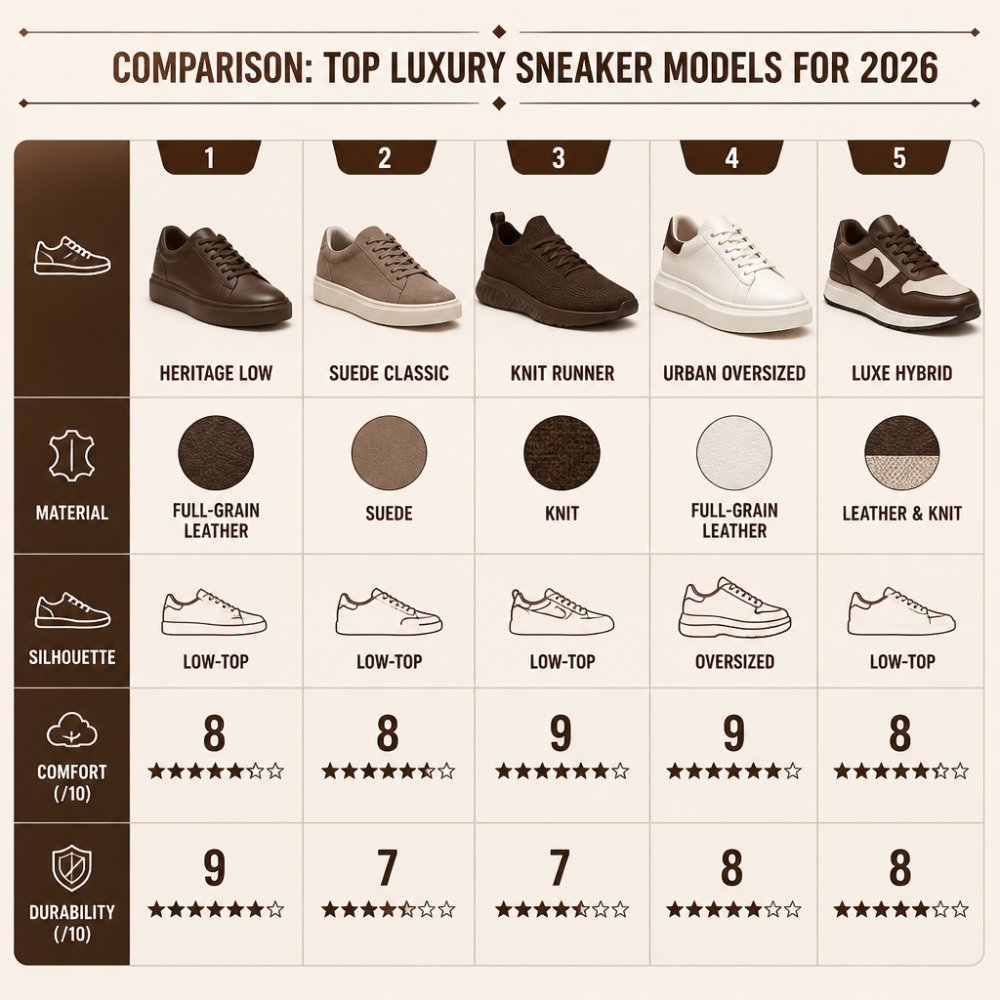
The table below summarizes the leading styles by material, silhouette, and strength. Use it to shortlist before you read the full breakdown.
| Model Style | Material | Silhouette | Best For | Standout Strength |
|---|---|---|---|---|
| Leather low-top | Full-grain leather | Low-top | Everyday wear | Ages gracefully, easy to clean |
| Suede low-top | Suede finish | Low-top | Smart-casual outfits | Soft texture, rich color |
| Knit runner | Engineered knit | Oversized | Travel and daily wear | Lightweight, breathable |
| Minimalist court shoe | Smooth leather | Low-top | Wardrobe essentials | Versatile styling |
| Chunky statement shoe | Mixed leather and mesh | Oversized silhouette | Statement style | Bold proportions |
Luxury sneaker brands fall into three practical camps: Italian leather houses, French and British heritage labels, and modern minimalist studios. Knowing which camp a pair comes from tells you more about how it will age than the logo on the tongue.
Italian makers built their reputations on full-grain and calfskin construction, Blake-stitched or stitched-and-turned soles, and hand-finishing. The trade-off is that many Italian sneakers use leather linings and leather insoles, which mold to the foot but offer less cushioning than a modern foam midsole.
What to look for: a stitched sole (not glued), a leather insole that can be replaced, and even stitching along the heel counter. These are the details that separate a shoe that can be resoled from one that is discarded when the sole wears through.
These houses often blend leather uppers with rubber cup soles and a more athletic last. They tend to run slightly narrower than Italian makers, so if you have a wide foot, size up or look for a brand that offers a wide fit.
A common pattern is that heritage labels release the same silhouette in seasonal colorways, which means you can often find last year’s color at a lower price without sacrificing construction.
Newer labels lean into quiet luxury: no visible logos, precise proportions, and restrained palettes. Many now offer responsibly sourced leather and knit uppers that weigh very little.
The trade-off is that minimalism shows wear faster if the material is thin. Check the leather or knit density before you commit. A useful test: press your thumb into the upper near the toe. If it creases sharply and stays creased, the leather is likely thin. If it springs back with a soft roll, it has more substance.
Instead of memorizing brand names, ask three questions:
A lesser-known label that answers yes to all three will often outlast a trend-driven pair from a famous house. That is the standard we apply at violeno.com when curating our collection of high-quality footwear.
Quiet luxury sneakers for men are footwear with no visible branding, refined proportions, and premium materials that signal quality through feel rather than logos. They suit professionals who want to look current without looking like a billboard.
This is the defining sneaker trend of 2026. Men’s fashion has swung decisively toward understated design, and the most versatile pairs are the ones you can wear to a client meeting and a weekend lunch without changing shoes.
A common mistake is confusing “plain” with “cheap.” True quiet luxury lives in the details: even stitching, a structured heel counter, and leather that softens rather than cracks. That is where the value sits.
Styling luxury sneakers for men comes down to matching the shoe’s formality to the rest of your outfit. A clean leather low-top sits at the smart-casual end of the spectrum; a chunky knit runner sits at the casual end.
Three combinations that work reliably:
Keep the palette tight. If your sneakers are the boldest item you own, let everything else stay neutral. If they are subtle, you have room to play with texture elsewhere.
Cleaning designer sneakers correctly is about matching the method to the material, not scrubbing harder. Leather, suede, and knit each need a different approach, and using the wrong one causes lasting damage.
Store your sneakers with shoe trees to hold their shape, and rotate pairs so each has time to dry. Rotating two or three pairs extends their life noticeably compared with wearing one daily.
The UK’s Waste and Resources Action Programme guidance on extending product life makes the case that good care is one of the simplest ways to keep quality footwear out of landfill. Treat your care routine as part of the purchase, not an afterthought.
Luxury sneakers generally run true to size, but leather and suede relax with wear while knit styles can stretch slightly. Buy for the fit you want in month two, not day one.
Break-in periods vary by material. Leather softens over a week or two of regular wear. Suede molds quickly but needs protection spray first. Knit sneakers need almost no break-in at all.
When ordering online, measure your foot in the afternoon when it is slightly larger, and check the brand’s own size chart rather than assuming. A half-size difference is common between houses.
Cost per wear is the honest way to judge value, but most guides stop at the phrase without showing you how to calculate it. Here is the framework we use.
Divide the purchase price by the number of times you expect to wear the pair over its life. A $400 sneaker worn 200 times costs $2 per wear. A $150 sneaker worn 40 times before the sole wears through costs $3.75 per wear. The cheaper shoe is more expensive to own.
The hard part is estimating wear count. Three factors drive it:
A cobbler can resole a well-built stitched sneaker for a fraction of the original price, which effectively doubles or triples its life. Glued shoes are usually discarded once the sole wears through because the repair cost approaches the replacement cost.
When evaluating a pair, ask:
A shoe that answers yes to all three is an asset. A shoe that answers no is a consumable.
Use this to compare two pairs side by side:
| Factor | What to Check | Why It Matters |
|---|---|---|
| Sole attachment | Stitched vs. glued | Stitched can be resoled |
| Upper material | Full-grain vs. corrected-grain | Full-grain ages, corrected-grain cracks |
| Insole | Removable vs. fixed | Removable can be replaced or upgraded |
| Lining | Leather vs. textile | Leather molds; textile wears faster |
| Heel counter | Structured vs. soft | Structured holds shape longer |
Score each pair out of five. A pair that scores four or five is likely to deliver a lower cost per wear than a cheaper pair that scores two.
Rotating two or three pairs extends the life of each noticeably compared with wearing one daily. The reason is moisture: feet sweat, and leather and suede need time to dry between wears. A day of rest lets the material recover its shape and prevents the interior from breaking down.
If you want to shop with confidence, browse a curated collection where every pair is selected for construction and longevity. That is the standard we hold at violeno.com.
For 2026, expect to see a continued rise in quiet luxury sneakers for men. This means minimalist designs, premium materials like soft leather and suede, and subtle branding over loud logos. Knit and lightweight sneaker styles are also gaining popularity for their comfort and breathability, making them ideal for everyday wear. The oversized silhouette remains a key trend, offering a modern, fashion-forward look that pairs well with relaxed tailoring.
Whether luxury sneakers are worth the price depends on what you value. They often use premium materials, offer superior craftsmanship, and can last longer with proper care, lowering their cost per wear. If you prioritize durability, timeless design, and a better fit, the investment can be justified. However, if you prefer to rotate through many styles, a more affordable option might suit you better.
Styling luxury sneakers for men is about balancing comfort and sophistication. For a smart-casual look, pair clean leather low-tops with tailored trousers and a blazer. For a more relaxed outfit, wear knit sneakers with dark denim and a cashmere sweater. Quiet luxury sneakers in neutral tones like white, grey, or navy are the most versatile. Avoid overly sporty designs with formal wear, and keep your sneakers clean to maintain a polished appearance.
Caring for designer sneakers starts with regular cleaning. Use a soft brush to remove dirt from suede and a damp cloth for leather. For deep cleaning, use a mild leather cleaner and condition after. Always air dry away from direct heat. Store them with shoe trees to maintain shape. For knit sneakers, hand wash with gentle detergent and let them air dry. Proper care will extend the life of your luxury sneakers and keep them looking new.