

Last Updated: October 21, 2026
Finding the best luxury sneakers for wide feet means confronting an uncomfortable truth: most designer footwear is built on a narrow last for a slim, tapered silhouette.
The problem is structural: luxury leather sneakers often use stiff, full-grain hides over a tapered toe box, leaving little room for a broader forefoot.
Below, we break down which luxury sneakers accommodate wide feet, how to judge fit before ordering, and where the trade-offs sit between style, comfort, and price.
The table below summarizes our top picks by category, construction, and wide-foot suitability. Prices vary by retailer and season.
| Sneaker | Style | Construction | Wide-Foot Suitability | Best For |
|---|---|---|---|---|
| Thursday Boots Premier Low Top | Leather low-top | Full-grain leather | Reported as a value wide-foot option | Dressier casual wear |
| Koio Capri | Minimalist leather | Italian leather | Named in wide-foot leather guides | Clean everyday styling |
| Nike Zoom Vomero 5 | Athletic | Mesh and synthetic | Named best overall in wide-sneaker testing | All-day cushioning |
| ASICS GT 2160 | Athletic | Mesh with stability frame | Named best stability pick | Overpronation support |
| Birkenstock Bend | Comfort-casual | Leather and cork | Highlighted for walking and travel | Travel and long walks |
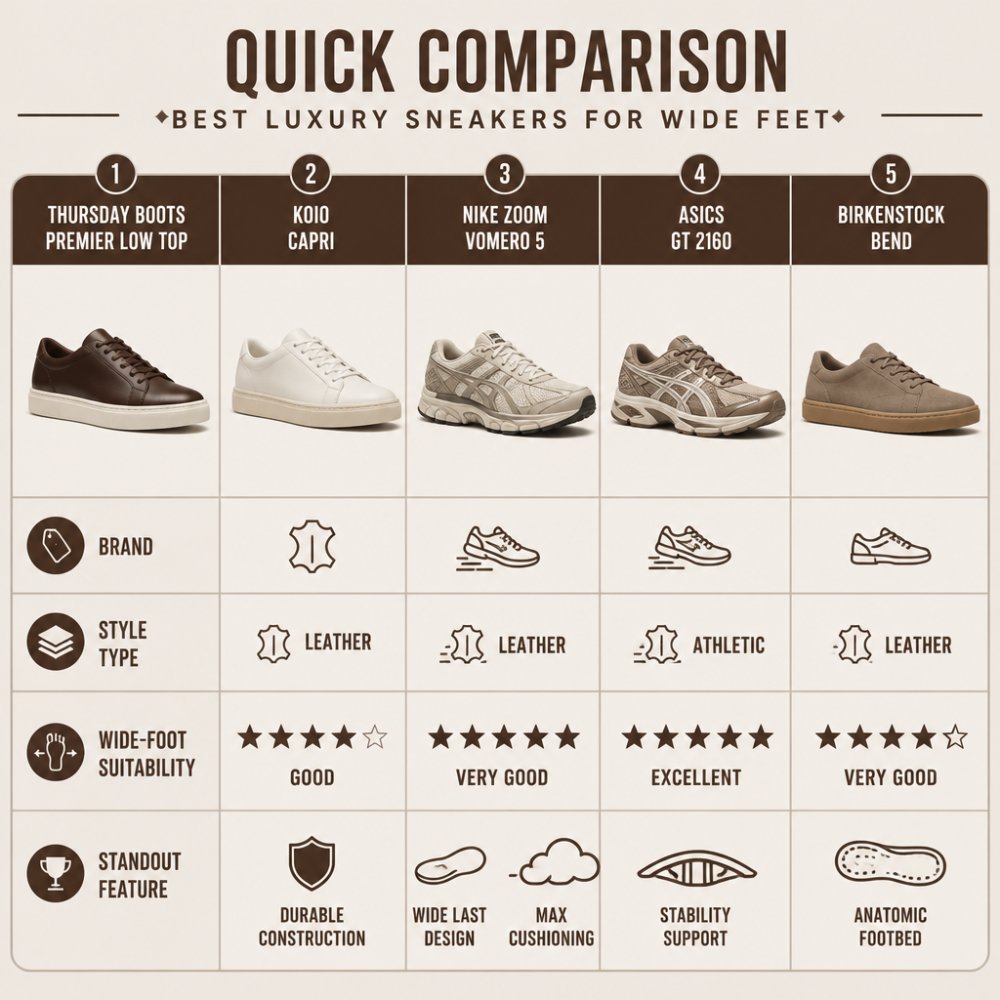
Below are the luxury and premium sneakers most frequently flagged in wide-foot guides and fit-focused reviews. Where a brand publishes width or toe-box measurements, we cite them; where it does not, we say so. Treat every fit claim as a starting point to verify against the brand’s size chart and return policy.
The Premier Low Top earns its place because wide-foot guides keep flagging it as a value pick in the leather low-top category.
Fit evidence: Thursday Boots publishes foot-length measurements, but not internal width. The rounded toe box gives more room than a pointed last.
Durability and trade-offs: Full-grain leather holds shape well, and the stitched outsole is repairable at a cobbler.
Koio’s Capri is a minimalist Italian-leather sneaker that appears in fit-focused guides covering leather options for wide feet. Its clean silhouette works with tailored trousers and denim alike.
Fit evidence: Koio does not publish a wide-width option or internal width measurements.
Durability and trade-offs: Italian leather and cupsole construction give a clean look and reasonable longevity, but the minimalist upper offers less lateral support.
RunRepeat’s 2026 wide-sneaker guide named the Zoom Vomero 5 its best overall pick.
Fit evidence: The Vomero line comes in standard and wide (2E) widths depending on the colorway. The mesh upper gives immediately rather than stretching slowly, suiting broad and high-volume forefeet.
Durability and trade-offs: Mesh uppers breathe well but wear sooner than leather and are harder to repair.
ASICS is named the best stability pick in RunRepeat’s 2026 wide-sneaker guide, and the GT 2160 shows what dedicated width engineering delivers. Like the Vomero, it is athletic, not luxury.
Fit evidence: ASICS publishes width options (standard and 2E/4E depending on the model) and size charts in centimeters. The stability frame and structured heel counter suit overpronators and high-volume feet, making this the benchmark to beat when comparing a luxury sneaker against a known wide fit.
Durability and trade-offs: Athletic mesh and foam midsoles wear faster than leather and are not repairable, so the cost-per-year math differs from a leather luxury sneaker. The styling is purely athletic.
The Bend is a comfort-casual sneaker highlighted in walking and travel guides for its leather-and-cork construction.
Fit evidence: Birkenstock publishes its size chart in millimeters, and its footbed is designed around a broader footprint than a typical fashion last.
Durability and trade-offs: Leather uppers and cork footbeds are repairable at a cobbler, and the cork molds to your foot over time.
Wide-width sneakers are built on a last that adds volume across the forefoot and toe box, rather than simply adding length. Sizing up gives you a longer shoe with the same narrow width, which is why your heel slips and your toes still feel pinched.
Three construction details determine whether a sneaker fits a wider foot:
A common mistake is buying on brand reputation rather than measured width: a luxury label with a narrow last fits worse than a mid-priced brand with a wide option.
Leather sneakers for wide feet live or die on two factors: the hide’s temper and how the shoe is lasted.
Suede is softer from day one and molds faster, but loses structure and shows wear sooner.
What most guides miss: the insole is often the cheapest fix.
Durability matters here too. A leather sneaker built on a narrow last wears unevenly, with pressure points at the pinky toe and outer edge.
Men’s designer extended-size shoes are where the market thins out fastest. Most luxury labels cap at a US 13 and offer a single width; extended sizing, when it exists, usually means length only. Each price tier solves the width problem differently.
Entry luxury (roughly the lower end of designer pricing): Brands here often use softer leathers and simpler lasts, giving slightly more forefoot room than structured fashion sneakers.
Mid luxury: This tier is where most wide-foot-friendly leather sneakers sit.
High luxury: Fashion-house sneakers in this tier are built on narrow, tapered lasts for a slim silhouette. They almost never offer wide sizing and rarely publish width measurements.
Width alone does not describe every fit need. Distinguish these patterns before you shop:
Buying expensive shoes online carries real risk, and the return policy is part of the fit. Before checkout:
Our advice: separate the two problems. If you need length, most luxury brands can help. If you need width, you are often better served by a brand that publishes a width chart, even if it is less prestigious. The ASICS GT 2160 is a useful benchmark for what a genuinely supportive wide fit feels like; compare any luxury option against that standard.
Judging fit online comes down to three checks: measured width against the brand’s published chart, return policy terms, and construction that accommodates your foot shape.
Use this checklist before checkout:
At violeno.com, we curate premium sneaker brands and pair them with styling guides, so you can match a well-fitting pair to your existing wardrobe, reducing the guesswork that makes online designer shopping risky.
The hardest part of buying luxury sneakers for wide feet isn’t finding a beautiful shoe. It’s finding one that fits without compromising on comfort or style. Measure your foot properly, favor brands that publish real width data, and lean on construction details like a rounded toe box and softer uppers.
At violeno.com, we stock a curated collection of premium sneaker brands alongside expert styling guides, so you can find a pair that fits your foot and your wardrobe.
Dedicated wide widths are rare among luxury labels, so most designer sneakers for wide feet rely on a roomy toe box rather than a labelled width. Leather low-tops from smaller premium makers tend to run more generously than slim Italian lasts. Check whether a brand publishes width measurements, and size up half a size if the forefoot feels tight. Trying a style in person or ordering from a retailer with a clear return policy remains the safest route.
Look for three signals: a square or rounded toe box rather than a tapered one, removable insoles you can swap for a thinner option, and product pages that list width in centimetres. Leather uppers relax slightly with wear, while suede stretches less predictably. Read reviews from buyers who mention forefoot width, and confirm the return window before you commit to a pair.
Leather sneakers for wide feet work well when the cut is generous. Full-grain leather softens and moulds to your foot over the first few weeks, easing pressure across the forefoot. Avoid stiff, heavily structured leather with a narrow last, since it will not give much. Suede is softer from day one but offers less stretch, so pick a style with a roomy toe box if you go that route.
Among athletic styles, Nike and ASICS models appear repeatedly in wide-foot guides, with the Zoom Vomero 5 named a best overall pick and the GT 2160 a stability pick in RunRepeat’s 2026 roundup. For leather options, Thursday Boots and Koio appear in wide-foot-focused guides. Luxury labels rarely publish width data, so treat any recommendation as a starting point and verify fit through measurements or returns.
Men’s designer extended-size shoes are more common in length than in width. Many premium brands extend to larger sizes but keep a standard width, which leaves wide-foot buyers relying on roomy silhouettes and half-size adjustments. Ask retailers directly whether a specific style runs wide, and prioritise shops that publish fit notes or offer easy exchanges so you can test the fit without risk.








Leave a comment