
Last Updated: October 18, 2026
Curated footwear is a hand-selected collection of shoes chosen by a retailer or stylist for quality, fit, and wearability, rather than a warehouse stocked with every model a brand makes. The point is subtraction, not addition. Someone has already filtered the noise.
That distinction matters more than most shoppers realize. A general retailer carries hundreds of styles and lets you sort it out. A curated shop carries fewer options and stands behind each one.
At violeno.com, we build our collection around premium sneaker brands and pair it with styling guides, so the selection and the advice arrive together. Here is the question worth asking before you spend more: is the curation doing real work, or is it just a nicer shelf?
The sneakers worth their price share three traits: materials that hold shape, construction that can be repaired, and a fit that stays comfortable after a full day. Miss any one of those and the premium is decoration.
What most guides miss is that price alone tells you very little. A shoe can cost more because of leather grade, because of labor, or because of markup. The shoe pricing guide from The Shoe Snob Blog breaks pricing into materials, labor, and markup, which is a useful lens: only two of those three actually reach your foot.
A common mistake is judging quality from photos. Look instead for:
Choosing quality shoes comes down to reading the materials, understanding how the sole is attached, and testing fit late in the day when your feet are at their largest. Get those three right and the brand name matters far less.
Start with materials. Full-grain leather tends to age better than corrected grain, and suede needs protection before its first wear. Construction decides whether a shoe can be repaired at all: a stitched sole can usually be replaced, while a cemented sole often cannot. Fit is the piece shoppers rush. Try shoes in the afternoon, walk on a hard floor, and check that your heel stays locked without pinching.
Shoe cost per wear is the purchase price plus ownership costs divided by the number of times you realistically wear the pair. It reframes a big upfront number as a small per-day one, and it exposes cheap shoes that fall apart fast.
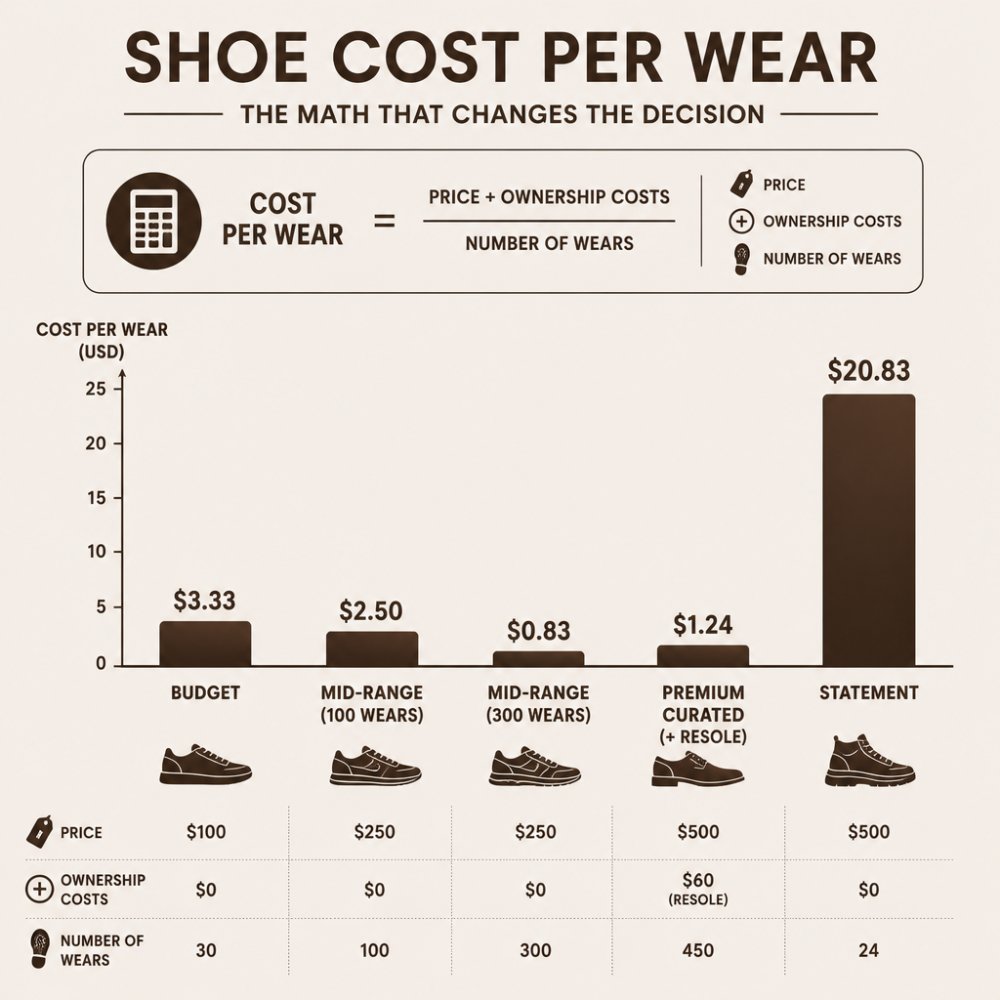
The formula is simple: cost per wear = (price + ownership costs) ÷ number of wears. Most guides stop there and plug in flattering wear counts.
Here is how the math behaves across realistic scenarios. These are illustrative examples, not quotes from any retailer:
| Scenario | Price | Realistic wears | Ownership costs | Cost per wear |
|---|---|---|---|---|
| Budget pair, worn twice a week for a season | $100 | 30 | $0 | ~$3.33 |
| Mid-range pair, worn twice a week for a year | $250 | 100 | $0 | ~$2.50 |
| Mid-range pair, worn three times a week for two years | $250 | 300 | $0 | ~$0.83 |
| Premium curated pair, worn three times a week for three years | $500 | 450 | $60 resole | ~$1.24 |
| Premium curated pair, worn once a week for three years | $500 | 150 | $60 resole | ~$3.73 |
| Statement pair, worn twice a month for a year | $500 | 24 | $0 | ~$20.83 |
The pattern is uncomfortable but clear: the same $500 shoe can cost $1.24 or $20.83 per wear depending entirely on how often you actually reach for it. Price tells you almost nothing until you supply the wear count.
Three variables move the number more than any other:
Famolare makes a similar case in its cost-per-wear comparison of leather shoes and sandals, arguing that durability and repeated use belong in the value conversation. If a pair only suits two outfits, the math collapses, and no amount of curation rescues it.
Curated footwear versus buying direct is a trade of money for filtering, fit guidance, and after-sale support. Buying direct can be cheaper per pair; curation can be cheaper per good decision. The difference only becomes clear when you compare the same shoe through both channels and ask what the curated retailer actually did to earn the gap.
First, what makes a selection curated rather than merely small. A curated shop typically applies stated criteria across five areas:
If a retailer cannot describe those criteria, the curation is likely a merchandising label rather than a service.
Here is the like-for-like comparison most shoppers never see laid out:
| Factor | Buying Direct | Curated Retailer |
|---|---|---|
| Selection | Full catalog, you filter | Pre-filtered by stated criteria |
| Price | Usually lower per pair | Higher per pair, justified by filtering |
| Materials | You verify from specs and photos | Retailer verifies and can explain grade |
| Comfort and fit | Size chart only | Fit guidance and known last behavior |
| Durability | Depends on your pick | Repairable construction prioritized |
| Service | Brand return policy | Retailer handles exchanges and advice |
| Time to decide | Longer, more comparison | Shorter, fewer dead ends |
| Cost per wear | Depends on your picks | Depends on curation quality |
That last row is the whole argument. Curation earns its premium when it steers you away from a pair you would have worn twice.
A practical way to run the comparison yourself is to take one shoe you are considering and price it through both channels. Then subtract the value of the guidance you would actually use: a fit consultation, a styling guide, a repair referral, an easier exchange. If the premium is larger than the value of those services to you, buy direct.
The Federal Trade Commission’s guidance on advertising claims is a useful backstop here: quality and performance claims are expected to be backed by evidence, which is why a credible curated retailer should be able to describe its selection process rather than rely on vague promises.
Long-term ownership costs decide whether a premium pair was worth it, and they are rarely in the sticker price. Resoling, protective sprays, shoe trees, and rotation all add up, while a well-made pair spreads those costs across years of wear.
The bespoke shoe blog’s analysis of long-term value makes the case that cost and benefit should be weighed over the life of the shoe, not at checkout. Practical ownership looks like this:
A pair that lasts three seasons with one repair usually beats three pairs replaced each season. The hidden cost is attention, and it is the one most shoppers forget to count.
Pay more for curated footwear if you wear the pair often, want guidance rather than a catalog, and plan to keep it for years. Skip the premium if the shoe is a one-off trend, if you enjoy the hunt, or if your wardrobe is still in flux.
Three shoppers who benefit most: the professional who wears the same rotation weekly, the buyer who has been burned by poor online fit, and the style-focused adult who wants a second opinion before committing. Three who should wait: the impulse buyer, the collector who already knows exactly what they want, and anyone whose size is still changing.
The honest answer is that curation is worth the price when it saves you from a bad pair and worthless when it does not. Ask any retailer to explain their selection criteria, then run the cost-per-wear math on your own habits before you commit.
At violeno.com, we built our collection around that idea: a curated selection of top sneaker brands, styling guides to help you pair them, and a quality standard applied to every product we list. Browse the collection, check the guides, and let the math decide.
Curated footwear is selected by a team that evaluates materials, construction, fit, and long-term wear before a shoe reaches the shelf. Instead of stocking every style, a curated collection narrows the field to pairs that meet specific quality and design standards. This means fewer options, but each pair has been vetted for durability and versatility. The difference is not just styling; it is the selection process that filters out shoes likely to disappoint after a few wears. You pay for that filtering, but you also avoid the cost of trial and error.
Premium sneakers often use better leather, stronger stitching, and more supportive soles than budget pairs. Whether they are worth the price depends on how often you wear them. If a premium sneaker fits your daily rotation and holds up over years, the cost per wear can be lower than a cheap alternative. Check the return policy and construction details before buying.
Divide the purchase price by the number of times you expect to wear the shoe. The formula helps you compare shoes across price ranges. Factor in repairs and resoling if you plan to keep them long-term. The lower the cost per wear, the better the value.
Check the materials first: full-grain leather, durable soles, and reinforced stitching are signs of quality. Look at the construction method, which allows for repair. Try the shoes on later in the day when feet are slightly swollen, and walk on hard surfaces to test support. Ask about the return policy and warranty. A higher price should come with transparent details about where and how the shoe was made. If the brand cannot answer those questions, proceed with caution.
The real challenge is not finding premium sneakers, it is knowing which pair will earn its place in your rotation. violeno.com pairs a curated collection of top sneaker brands with expert styling guides and a commitment to rigorous product testing, so you can buy with confidence instead of guesswork. Get started with violeno.com and build a wardrobe where every pair pulls its weight.







Leave a comment