
Last Updated: October 19, 2026
Most people judge a designer shoe by the box, the receipt, or the price tag. That is exactly backwards.
Knowing how to identify authentic designer footwear is a skill, not a secret.
Here is the uncomfortable truth: the counterfeit market has gotten good at copying logos. It has not gotten good at copying craftsmanship.
Below, we break down seven checks, from silhouette to serial codes, plus the red flags that show up in listing photos before you ever pay.
Start with the big picture, then zoom in. Authentic designer shoes hold their shape, sit evenly on a flat surface, and feel balanced in the hand. Fakes often look slightly “off” before you can explain why: a squashed heel, a leaning toe box, a sole that curves where it shouldn’t.
Lay the shoe on a table and look at it from the side. The heel counter should stand upright, the toe box should hold its shape, and the sole should sit flat.
A common mistake is judging shape from a single angled photo. Ask for a straight side profile and a top-down shot.
Stitching is where counterfeiters cut corners. Look for even spacing, tight tension, and clean seam joins. On a real pair, the stitch count per centimetre stays consistent around curves.
Glue is the giveaway nobody talks about. Authentic pairs use it sparingly and cleanly. Visible excess glue along the sole line is a red flag.
Put a suspected pair next to a known reference and the differences jump out. This is the fastest way to spot fake vs real designer sneakers, and it is how most authenticators work.
| Check | Real Pair | Fake Pair |
|---|---|---|
| Stitching | Even, tight, consistent | Loose, uneven, skipped |
| Leather | Soft, even grain, matte | Plastic sheen, uniform grain |
| Sole | Firm, clean glue line | Soft, messy glue, uneven tread |
| Logo | Crisp, correctly spaced | Blurry, thick, off-centre |
| Label | Clean print, correct font | Smudged, wrong font weight |
| Smell | Leather and rubber | Chemical, glue-like |
The scent test is real. Genuine leather smells like leather. Synthetics and cheap adhesives smell sharp and chemical. It is not proof on its own, but it is a useful early signal.
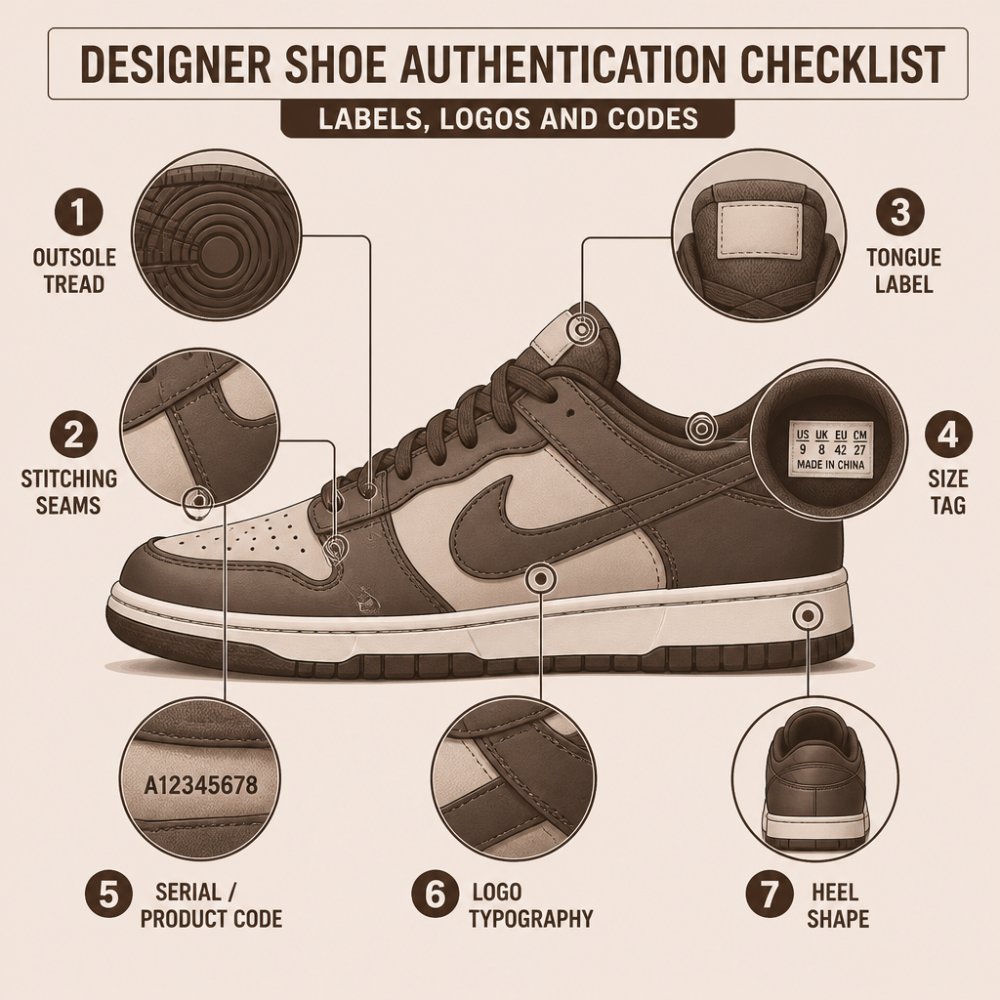
Labels and codes are the paper trail of a shoe. A designer shoe authentication checklist always includes them, but they are supporting evidence, not the whole case. Counterfeiters can copy a logo.
The problem with most checklists is that they stop at “check the label.” That is not actionable. What actually helps is knowing how to find the correct reference for the specific brand and model in front of you, then comparing like for like.
Before you judge a label, establish what the label is supposed to look like for that exact model and production era. Brands change fonts, tag layouts, and code formats over time, so a “wrong” label may simply be an older or regional version.
A practical sequence most authenticators follow:
A common pattern is that fakes get the current-season label right and the older or regional variants wrong, or vice versa. Matching the reference to the production era is what separates a real check from a guess.
Typography is a fingerprint. Every luxury house uses specific fonts with exact letter spacing. Compare the logo on the shoe to the brand’s official product images for that model, not to a logo you remember.
The size tag inside the tongue or heel should be cleanly printed, with consistent fonts and correct sizing conventions for that brand and region. Packaging matters too: dust bags, spare laces, and boxes should match what the brand actually ships for that model and era.
A designer shoe serial number check confirms that the code exists and matches the brand’s format. It does not confirm the shoe is real. Codes get copied, reused, and printed onto fakes every day.
Here is what a serial or product code can tell you:
What it cannot tell you: whether the shoe in your hand was made in the brand’s factory. Treat codes as one clue among many.
QR codes, barcodes, serial numbers, and product codes are useful for cross-checking, but none of them is proof of authenticity on its own. A scannable code only proves that a code exists and resolves to something.
A common pattern is that counterfeiters invest in a convincing digital layer because buyers trust it. The code is the easiest part to copy; the construction is the hardest.
Visual inspection has a ceiling. Convincing counterfeits can reproduce visible details, including stitching density, label fonts, and sole tooling, closely enough that photos and a quick checklist are not sufficient.
When visual checks are not enough:
This is also where professional authentication services earn their fee: they combine physical inspection with brand-specific references and, in some cases, provenance checks that a buyer cannot replicate from a listing.
Genuine leather versus synthetic material is often the clearest tell. Real leather has an irregular grain, soft creases, and a matte finish.
Check the insole and lining, not just the upper. Luxury brands use quality lining because it touches the foot.
The tread is underrated. Fake soles often have soft, shallow tread that wears fast. Real outsoles are firm and precisely moulded.
The safest authentication happens before you pay. Photos and seller behaviour reveal a lot if you know what to look for. This is where most buyers skip steps and get burned.
Red flags in listing photos:
Seller due diligence:
FTC guidance on avoiding online shopping scams is worth reading before any high-value purchase. It covers the tactics fake sellers use most.
At violeno.com, we know the worry about buying without trying on.
The hardest part of authentication is accepting that no single check proves anything. A perfect logo means little if the stitching is loose. A valid code means little if the leather feels like plastic.
If you are unsure, buy from a source that stands behind its products. At violeno.com, we curate premium sneaker brands with rigorous product selection, offer styling guides to help you build outfits around your purchase, and keep the shopping experience simple from browse to delivery.
Start with construction: shape, silhouette and proportions should match the brand’s reference pair. Then inspect stitching for even spacing and clean seams, check the upper and lining for genuine leather texture and scent, and verify the outsole tread pattern. Move on to logos and typography, size tags, product codes and packaging. Photograph each detail and compare against official brand images. No single detail proves authenticity, so treat the checks as a group and walk away if several feel inconsistent.
No. A serial number or product code is a useful part of a designer shoe serial number check, but counterfeiters copy codes from genuine pairs, so a matching number only shows the code exists. Use it to confirm the style, season and colorway, then verify the code’s placement, font and stitching against brand references. Treat the code as one signal among many, not a guarantee, and be cautious of sellers who lead with the code as their main proof.
Not always. Pre-owned pairs are often sold without the original box, and some boutiques supply different packaging. Missing packaging is a caution flag, not proof of a fake. What matters more is whether the box, dust bag and extra laces match the brand’s known style for that model and season. If a seller claims a pair is new but the packaging looks generic or the labels are misspelled, ask for more photos and receipts before paying.
Stop wearing them and photograph every detail: labels, stitching, soles, packaging and the listing. Contact the seller in writing and request a return under their policy, then escalate to your payment provider or card issuer if the seller refuses. Report the listing to the platform. If you are unsure, pay for an expert assessment from a reputable authentication service before making accusations. Keep all messages and receipts, since a clear paper trail is what supports a refund or dispute.








Leave a comment