
Last Updated: October 12, 2026
The core promise is personalization. A generic blog post tells everyone to pair white sneakers with straight-leg jeans.
Here’s the honest part most roundups skip: a guide is only worth it if you’ll use it.
Below, we’ll show you how to judge a styling guide before you pay, and who should skip paid guides entirely, plus a simple framework for styling luxury sneakers.
Professional styling guide cost varies by format, and the price usually reflects access to a person rather than the document itself. A downloadable PDF sits at the low end; a guide bundled with email support or a video call sits higher; ongoing subscription styling higher still.
What you’re really paying for breaks down into four things:
Pricing for violeno.com’s digital styling resources depends on the specific guide and any current bundle, so check the site for the latest figures. The same caution applies across the category: a guide’s value only means something once you know what support comes with it.
The honest answer to paid styling guide vs free fashion advice is that free advice wins on volume and paid advice wins on fit. YouTube, Pinterest, and fashion blogs hand you unlimited inspiration at no cost, but they cannot look at your wardrobe and tell you which three combinations will work tomorrow morning.
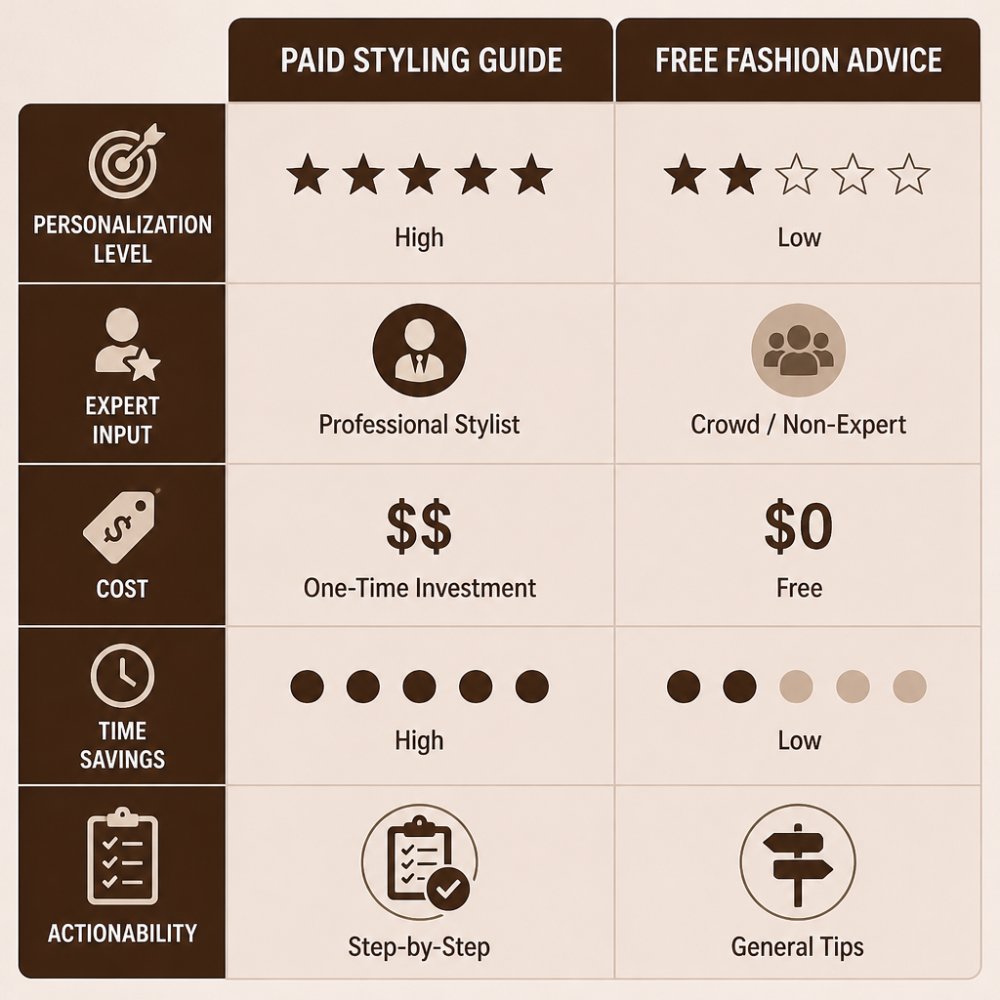
| Criteria | Paid Styling Guide | Free Fashion Advice |
|---|---|---|
| Personalization | Built around your body and wardrobe | One-size-fits-all |
| Expert input | Working stylist or trained editor | Varies, often unverified |
| Cost | One-off or subscription fee | Free |
| Time to result | Fast, pre-filtered for you | Hours of trial and error |
| Actionability | Specific outfits and pairings | General inspiration |
Most buyers compare the guide’s initial investment to zero and stop there. The real comparison is total cost of ownership: guide investment plus the tools, products, and pieces it tells you to buy.
A practical frame: estimate the outfits you’d realistically wear from the guide in 12 months, then divide total cost by that number. This provides a far better test than the sales page’s promise.
Free advice isn’t just YouTube hauls. Three free options do real work:
“It felt worth it” is not a measurement. Four metrics separate a guide that paid off from one that didn’t:
According to Statista’s consumer fashion spending data, shoppers increasingly research purchases online before committing, which means the real cost of bad styling advice is the money wasted on pieces that never leave the wardrobe.
A guide’s usefulness decays as trends and tools change. Before buying, ask how it handles updates: seasonal refreshes, a private community, or a channel for follow-up questions? A three-year-old PDF may still teach timeless principles like proportion and palette, but it won’t help with current silhouettes or new tool categories. Guides with ongoing access justify a higher price because they don’t expire on download.
Personal styling guide benefits show up fastest in three places: fewer impulse buys, more outfits per item, and a morning routine that stops eating your time. The measurable win isn’t a new wardrobe.
Think about a typical professional’s closet: a core of pieces worn constantly and a graveyard of impulse buys.
A common mistake is treating a personal styling guide as a shopping list.
Learning how to style luxury sneakers comes down to proportion, palette, and occasion. A clean low-top works with tailored trousers and a knit.
Here’s the framework we’d use, applied to a pair of minimalist leather sneakers:
This is the kind of specific, repeatable instruction a good guide provides, a framework you can apply beats a mood board you can only admire.
At violeno.com, our styling resources pair a curated sneaker selection with guidance on how to wear it.
Professional styling guides pay off for a specific kind of reader, and it’s worth being blunt about who should save their money. Guides reward people who already have a wardrobe and a budget and need coordination rather than discovery. But first you need a way to judge the guide itself, a bad guide fails even the readers it should help.
Run every guide through these six tests before paying:
The right call depends on four variables, not one:
By skill level. Beginners still discovering their taste get more from free browsing and a free retail stylist appointment. Intermediate dressers who know what they like but struggle to combine it are the sweet spot for paid guides. Advanced dressers usually need a personal stylist, not a PDF.
By hair texture and type.
By styling frequency. Someone who dresses for a defined context (office, events, a dress code) five days a week extracts far more value per dollar than someone who dresses casually twice a week.
By budget. If your clothing budget is tight, the guide fee competes directly with the clothes themselves. Free advice plus a disciplined photo audit of your existing wardrobe delivers more real value than any paid PDF.
A guide that assumes unlimited time, a full closet, or no mobility limitations excludes real readers.
You’ll get the most from a guide if you:
You should probably skip paid guides if you:
The middle ground is where most readers land. A single well-made guide, applied to a wardrobe you already own, tends to deliver more than a subscription you forget to open, provided it passes the checklist above.
Business of Fashion’s analysis of the resale and luxury market notes that shoppers increasingly value guidance that helps them buy fewer, better pieces, which is exactly the case a good styling guide makes.
It depends on your goals and how you value your time. A professional styling guide typically costs less than a single personal shopping session and provides structured, reusable advice you can apply to multiple outfits. If you own luxury sneakers but struggle to integrate them into your wardrobe, the right guide can save you from costly trial-and-error purchases. However, if you already have a clear personal style and strong styling skills, free advice may be sufficient. Consider whether you need expert curation or just inspiration.
A high-quality professional styling guide should include clear visuals, outfit formulas, guidance on coordinating colors and textures, and specific recommendations for different body types and occasions. For luxury sneaker styling, look for sections on matching sneakers with tailored clothing, casual looks, and seasonal transitions. The guide should also explain the reasoning behind each recommendation so you can adapt it to your own wardrobe. Avoid guides that rely solely on generic tips without concrete examples or that push specific products without transparency.
Paid guides offer structure, expert curation, and time savings that free advice often lacks. Free content can be excellent for inspiration, but it’s scattered across blogs, social media, and videos, requiring you to filter out irrelevant or contradictory tips. A paid guide consolidates professional recommendations into one actionable resource. The trade-off is cost. If you have more time than budget, free advice can work. If you want a shortcut to polished results and are willing to invest, a paid guide may deliver better value.
Yes. A well-designed styling guide teaches you how to mix and match existing pieces in new ways, often revealing combinations you hadn’t considered. For example, a guide focused on luxury sneakers might show how to pair the same sneakers with tailored trousers for work, denim for weekends, and knitwear for evenings. This approach maximizes your current wardrobe without requiring new purchases. The key is choosing a guide that aligns with the items you already own and the occasions you dress for.
The challenge isn’t finding advice. It’s finding advice built for your wardrobe, your budget, and the way you actually dress. At violeno.com, we pair a curated collection of premium sneaker brands with expert styling guides and digital downloads, so you get both the pieces and the know-how to wear them well. Every product is selected with care and held to rigorous quality standards. Get started with violeno.com and turn the wardrobe you already own into one you’re glad to open.







Leave a comment